
Why your website is quietly going out of date
Read more
Building something with AI is the fun bit. Making that thing something your customers can rely on is another job entirely. Having just been through this exercise with a client, here’s what we've learned, and what we’d ask before you launch.
AI means people can build things that would never have survived the budget conversation. A tool your customers use every day. A dashboard that keeps an eye on your competitors while you get on with the job. That’s brilliant, and we’re all for it. But getting something to work on your laptop is one job. Getting it ready for customers or the business to rely on is another, and it’s usually the bigger of the two. It’s also hard to judge, because AI makes everything look finished.
Most of us can’t tell a sound piece of code from a fragile one. That’s fine. Nobody expects a business leader to read code. The trouble is that things built with AI look polished from day one. The buttons work, the layout is tidy, and it does what you asked.
So it’s reasonable to assume you’ve done 90% of the job and someone just needs to tidy up the rest. Sometimes that’s true. Sometimes the last 10% is a rebuild.
Either way, the bit that’s left is usually the unglamorous part. It decides whether the thing handles your customers’ data properly, and whether it’ll still be running in a year’s time.
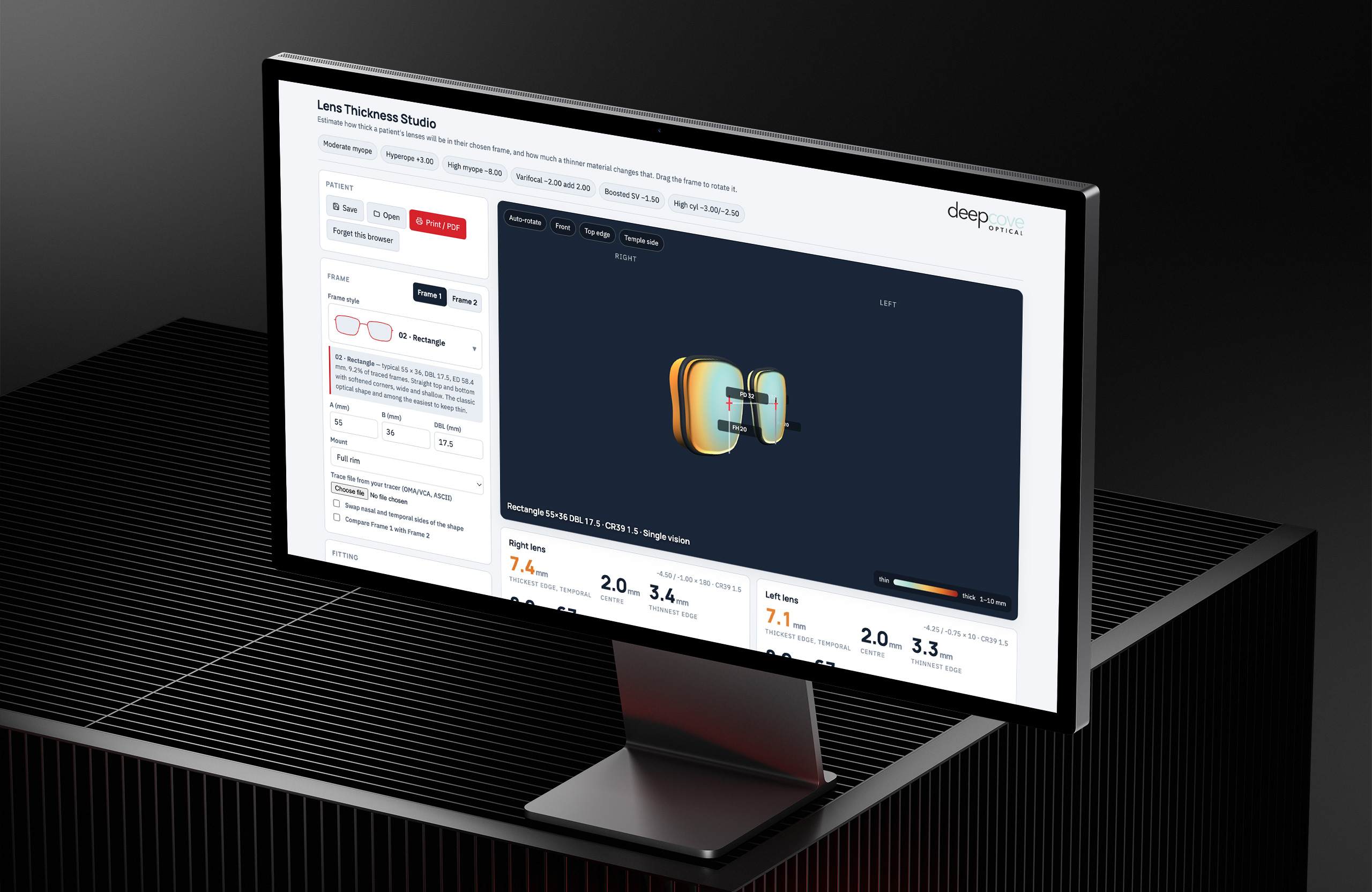
Roland runs Deepcove Optical, a lens supplier to independent opticians. He built a tool his customers can use in the consulting room. Pick a frame, enter a prescription, and show the patient in 3D exactly how thick their lenses will be in each material. With AI, it took him about two days, some of them on a train to a conference.
Built the traditional way, it would have cost tens of thousands of pounds, and the business case is indirect. Deepcove gives the tool away. The return comes from fewer ordering mistakes at the practice, and in Roland’s world, mistakes cost the supplier. It’s a good idea, but not one you’d easily sign off a five-figure build for.
The tool worked. It started life inside his AI chat, then became a file he could download and send to customers. But once that file was on someone else’s computer, it couldn’t be updated, and he had no way of knowing who was using it. He didn’t know how to fix either problem.
“The heart of it came together really quickly. About 90% of the creative process and the build happened in 24 hours. Then, like most projects, the tuning and polishing took a lot longer. What I had at the end was this wonderful app, but I didn’t really know how it fitted into the world around it. It was an HTML file sitting in my Dropbox folder.”
Roland Allen, Deepcove Optical
What we did
Matt, our Head of Digital, moved the tool out of the chat and onto Deepcove’s own site. It now has version control, backups and a proper deployment process, so a change can be tested before it goes live and rolled back if something goes wrong.
Then came the part Roland couldn’t do without help. He wanted to know which practices were using the tool, so access now goes through a form linked to Deepcove’s HubSpot account. That meant making decisions you can’t rely on an AI to make well on its own: what’s worth tracking, and what must never leave the practice. Patients’ private health data stays on the optician’s own computer.
“Getting into his HubSpot account was like logging into a bank. There’s a reason for that: it’s real customer data, and anything you connect to it needs proper guardrails.”
Matt Leach, Head of Digital
The tool is live at deepcove.eu/lens, and it’s early days. Roland sent it to a handful of customers to try, and the reaction was “Oh, it looks great”. Proper promotion starts this week, through Deepcove’s customer email, with a link in the ordering system opticians already use every day to follow.
Nobody is using it in numbers yet, and Roland is refreshingly honest about why.
“Communication is still the biggest challenge. That hasn’t become any easier. You’ve got to tell people seven times before they even remember it exists.”
Roland Allen, Deepcove Optical
What has changed is that he’ll know whether it’s working. Every download shows up in HubSpot, and anyone new becomes a contact Deepcove’s sales team can follow up. A tool built for existing customers is now a way to find new ones. That’s the difference between an app sitting in a folder and something a business can measure.
Roland’s tool is a useful example because it’s so ordinary. Nothing went wrong. It just needed finishing. If you’ve built something with AI, these are the questions worth answering before anyone outside your business depends on it.
If the answer is “in my AI chat” or “on the platform I built it with”, you don’t fully control it. Often the sensible approach is to use AI to make the thing quickly, then move it somewhere a developer can work on it directly. That might be an inexpensive server that a real person can switch on and off. It’s what we did for Deepcove.
If it breaks on a Friday afternoon, who do you call? Asking the AI to fix it can work, but it can also make things worse. Without version control and backups, there’s no easy way back. If a change goes wrong and deletes your blog posts, the AI’s best offer may be to write them again.
Building something with AI is cheap. The bigger question is how you’ll keep working on it once it’s live.
One option is to keep an AI tool hooked up and ask it to make every change. That can work, but you pay for AI usage on every edit, however small, and the AI companies are still working out what these tools really cost to run. That might suit you now and not in two years. The alternative is to use AI to build it, then hand it to someone who can maintain it directly.
A friend of ours built his website with an AI tool. It asked if he wanted to publish, he said yes, and it changed his domain settings to put the site live. It didn’t know he also ran his email through that domain. Three clicks later, his business couldn’t send or receive a single message.
AI is very good at the task in front of it. It’s much less good at knowing what else is plugged in. Your domain, your email, your customer records and your hosting account can all be changed by a well-meaning AI that doesn’t know what depends on them.
Sooner or later, a customer, an investor or an auditor will ask how your product handles data. Where is it stored? Does it stay in the UK? You’ll want a better answer than “I’ll ask the AI”.
This is also where judgement matters most. AI can tell you when you’re wrong, but you can’t rely on it to challenge your thinking. It’s designed to be helpful, which often means agreeable. Ask one to “track everything” and it will usually try. Deciding that patient details should never leave the practice took someone who understood Roland’s business.
It’s a bit like searching your symptoms online rather than seeing a doctor. The search works with what you type in. The doctor knows which questions to ask. And sometimes the most useful thing an expert can tell you is that something doesn’t need building at all.
None of this is a reason not to use AI. We use it every day, and some of our most useful internal tools started as experiments. Flight Deck, which runs much of how we manage digital projects, exists because AI let us build it quickly. It would never have been worth weeks of development. The same goes for the tool that chases timesheets so our project manager doesn’t have to.
If you’ve built something with AI and you’re not sure it’s ready, get in touch, we offer a peace of mind check. Matt or one of our developers will spend half a day with you, look at what you’ve built, and point out the likely risks and what’s fine as it is. We won’t try to sell you a rebuild you don’t need.
If you need help finishing it and keeping it running, that’s what we’ve been doing for clients for twenty-five years. Plenty of them trust us with the keys to their domains and websites.
You’ve done the exciting part. Let’s make sure it lasts.